






Μπαταρία 12V 100Ah μπροστινού ακροδέκτη (βαθιάς εκκένωσης) έναντι λιθίου: Ποια είναι η πιο έξυπνη επένδυση σε UPS το 2026;
Release time: 2026-02-26
Global telecom infrastructure spending is shifting dramatically in 2026, forcing network engineers and data center managers to ruthlessly audit their backup power budgets. While lithium-ion technology continues to dominate industry headlines with promises of extreme lifespans, the reality on the ground tells a much more nuanced story. Facilities managers upgrading aging UPS systems or outfitting remote 5G base stations are constantly weighing massive upfront costs against proven reliability. In this high-stakes environment of network uptime, the debate between cutting-edge lithium and the battle-tested 12V 100Ah Front Terminal Battery has never been more relevant for B2B procurement.
The CAPEX Reality: Balancing Budgets and Deployments
When deploying backup power across dozens or hundreds of remote network sites, initial capital expenditure (CAPEX) heavily dictates your engineering choices. A standard lithium iron phosphate (LiFePO₄) battery bank easily costs three to four times more upfront than its lead-acid equivalent. For hyper-scale data centers with virtually unlimited infrastructure budgets, absorbing this cost over a ten-year horizon might make financial sense.
However, for regional telecom operators and IT managers working with strict quarterly limitations, sinking massive funds into lithium severely restricts overall network expansion. Choosing a high-quality Front Terminal Battery allows you to secure robust, code-compliant backup power immediately. This practical approach frees up critical budget for active server hardware, cooling upgrades, and antenna deployments rather than tying up capital in dormant energy storage.
Thermal Stability and Harsh Environment Safety
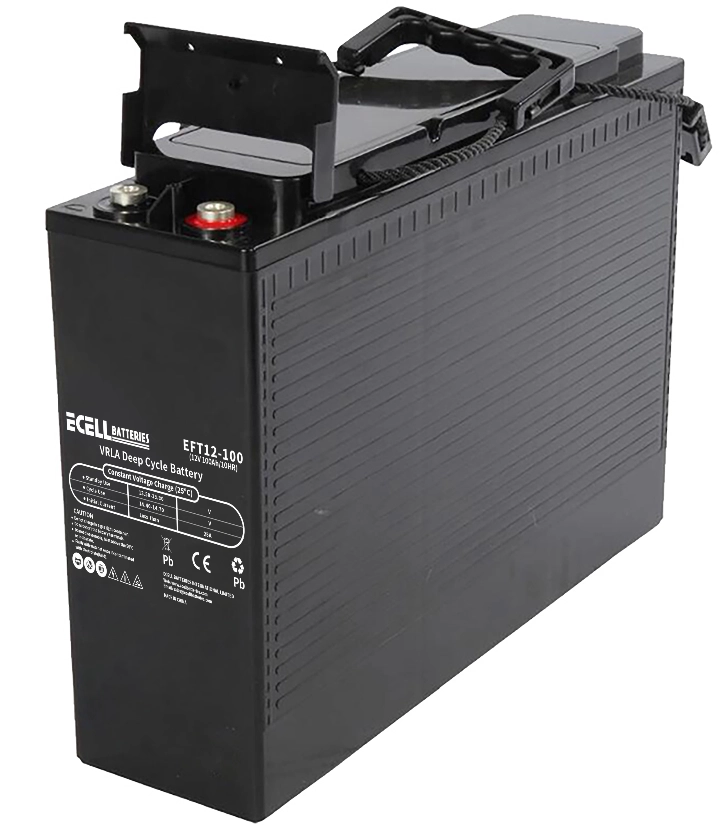
Remote telecom cabinets and edge computing nodes frequently operate in brutal environments where climate control is either minimal or entirely absent. Lithium batteries demand complex Battery Management Systems (BMS) to actively prevent catastrophic thermal runaway when ambient temperatures spike. If a cooling fan fails in a remote desert base station, a lithium bank can quickly become a severe fire hazard, or it may abruptly shut itself down to protect its cells, dropping your network offline.
Conversely, Absorbent Glass Mat (AGM) chemistry is inherently stable and highly forgiving. It does not require a sensitive electronic brain to function safely under duress. Even in sweltering summer heat or freezing winter dips, an AGM string will continue to deliver stable float voltage without the risk of spontaneous combustion. This inherent chemical safety ensures your critical infrastructure stays online even during cascading HVAC failures.
Maximizing Rack Density Without Sacrificing Access
Physical footprint is the ultimate premium in modern network enclosures. Both battery chemistries attempt to solve space constraints, but the mechanical exterior design matters just as much as the internal chemistry. Standard top-terminal batteries force technicians to leave empty vertical space for cable routing and wrench clearance, wasting valuable rack units (U-space) that could be used for routing equipment.
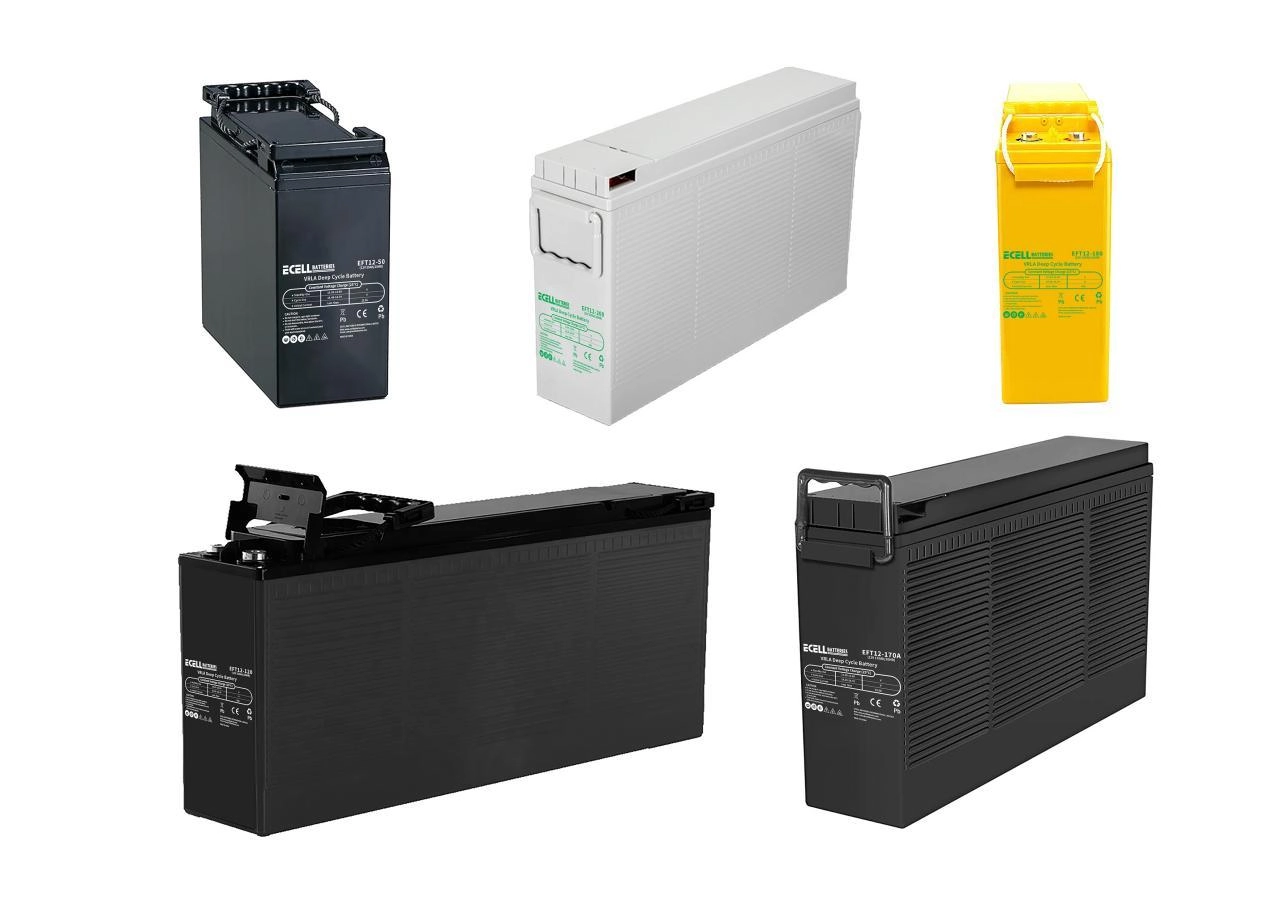
The Front Terminal Battery completely eliminates this layout bottleneck. Engineered specifically to slide into standard 19-inch and 23-inch ETSI telecom cabinets, its terminals face directly outward. Technicians can rack these units tightly together and connect solid copper bus bars across the front panel in a matter of minutes. This design maximizes your power density per square foot while keeping routine maintenance entirely safe and front-facing.
To understand exactly how these slim profiles integrate into standard racks, review the precise dimensions of the ECELL BATTERIES EFT Series below. Notice how the 12V 100Ah models (such as the EFT12-100 and EFT12-100L) maintain a narrow width (110 mm) specifically designed for deep telecom enclosures:
| Σειρά | ΜΠΑΤΑΡΙΕΣ ECELL Μοντέλο | Δυναμικό (V) | Ικανότητα (ΑΧ) | Εκτίμηση | Διάσταση (mm) | Τερματικό | Βάρος (κιλά) ±3% | Συσκευασία τεμ./κοντέινερ | Τύπος | |||
| L | W | H | ΘΕ | |||||||||
| ±1 | ±1 | ±2 | ±2 | |||||||||
| Ηλεκτρονική Μεταφορά Χρημάτων (ΗΜΧ) | EFT12-50 | 12 | 50 | 10 ώρες | 291 | 106 | 221 | 231 | R4/M4*14 | 15.30 | 1 | Ετήσια Γενική Συνέλευση VRLA |
| EFT12-55 | 12 | 55 | 10 ώρες | 291 | 106 | 221 | 231 | R4/M4*14 | 17.00 | 1 | Ετήσια Γενική Συνέλευση VRLA | |
| EFT12-65 | 12 | 65 | 10 ώρες | 410 | 110 | 286 | 295 | R4/M4*14 | 22.00 | 1 | Ετήσια Γενική Συνέλευση VRLA | |
| EFT12-75 | 12 | 75 | 10 ώρες | 410 | 110 | 286 | 295 | R5/M8*16 | 24.00 | 1 | Ετήσια Γενική Συνέλευση VRLA | |
| EFT12-80 | 12 | 80 | 10 ώρες | 562 | 114 | 189 | 189 | R5/M8*16 | 24.50 | 1 | Ετήσια Γενική Συνέλευση VRLA | |
| EFT12-90 | 12 | 105 | 10 ώρες | 506 | 110 | 224 | 239 | R5/M8*16 | 29.40 | 1 | Ετήσια Γενική Συνέλευση VRLA | |
| EFT12-100M | 12 | 100 | 10 ώρες | 507 | 110 | 223 | 238 | R5/M8*16 | 34.00 | 1 | Ετήσια Γενική Συνέλευση VRLA | |
| EFT12-100A | 12 | 100 | 10 ώρες | 506 | 110 | 224 | 239 | R5/M8*16 | 31.00 | 1 | Ετήσια Γενική Συνέλευση VRLA | |
| EFT12-100L | 12 | 100 | 10 ώρες | 396 | 110 | 286 | 286 | R5/M8*16 | 31.00 | 1 | Ετήσια Γενική Συνέλευση VRLA | |
| EFT12-100 | 12 | 100 | 10 ώρες | 410 | 110 | 286 | 295 | R5/M8*16 | 31.00 | 1 | Ετήσια Γενική Συνέλευση VRLA | |
| Ηλεκτρονική μεταφορά χρημάτων 12-110 | 12 | 110 | 10 ώρες | 410 | 110 | 286 | 295 | R5/M8*16 | 33.00 | 1 | Ετήσια Γενική Συνέλευση VRLA | |
| EFT12-150 | 12 | 150 | 10 ώρες | 550 | 110 | 287 | 287 | R5/M8*16 | 44.00 | 1 | Ετήσια Γενική Συνέλευση VRLA | |
| EFT12-155 | 12 | 155 | 10 ώρες | 550 | 110 | 287 | 287 | R5/M8*16 | 48.50 | 1 | Ετήσια Γενική Συνέλευση VRLA | |
| EFT12-170 | 12 | 170 | 10 ώρες | 550 | 110 | 287 | 287 | R5/M8*16 | 50.00 | 1 | Ετήσια Γενική Συνέλευση VRLA | |
| EFT12-180 | 12 | 180 | 10 ώρες | 560 | 125 | 316 | 316 | R5/M8*16 | 53.80 | 1 | Ετήσια Γενική Συνέλευση VRLA | |
| EFT12-180M | 12 | 180 | 10 ώρες | 545 | 125 | 316 | 323 | R5/M8*16 | 57.20 | 1 | Ετήσια Γενική Συνέλευση VRLA | |
| EFT12-190 | 12 | 190 | 10 ώρες | 560 | 125 | 316 | 316 | R5/M8*16 | 55.50 | 1 | Ετήσια Γενική Συνέλευση VRLA | |
| EFT12-200 | 12 | 200 | 10 ώρες | 560 | 125 | 316 | 316 | R5/M8*16 | 57.00 | 1 | Ετήσια Γενική Συνέλευση VRLA | |
End-of-Life Logistics and Corporate Sustainability
In 2026, corporate ESG (Environmental, Social, and Governance) goals heavily influence hardware procurement. When a backup system reaches the end of its operational life, disposal becomes a significant operational expense (OPEX). Lithium recycling infrastructure remains fragmented, expensive, and logistically complex, often requiring companies to pay hefty fees just to dispose of depleted cells safely.
Valve-Regulated Lead-Acid (VRLA) technology, on the other hand, boasts the most successful recycling loop on the planet. Over 99% of a lead-acid battery is easily fully recyclable. When you replace a μπαταρία μπροστινού ακροδέκτη bank, recycling facilities will often pay you for the scrap lead, turning a disposal headache into a reliable cost-recovery mechanism that directly offsets the price of your replacement units.
Making the Right Technical Choice for 2026
Deciding between these two dominant technologies ultimately comes down to your specific operational constraints rather than chasing the latest industry trends. Here is a quick breakdown to guide your engineering team:
- Invest in lithium if you are building an indoor, heavily climate-controlled facility where extreme floor-weight reduction is mandatory, and your upfront budget is flexible.
- Invest in Front Access AGM if you need highly reliable, fire-safe power for remote outdoor cabinets, face strict CAPEX limitations, and require immediate, seamless integration into standard telecom racks.
For the vast majority of distributed network nodes and commercial UPS upgrades, proven stability and cost-effectiveness still outrank theoretical longevity. Standardizing your infrastructure around the AGM chemistry provides a fail-safe, budget-friendly solution that deploys rapidly and performs predictably year after year.