







12V vs 24V LiFePO₄ Battery Architecture: Which Is Best for Your Energy Storage System?
Release time: 2026-01-27
Struggling to choose between 12V and 24V for your solar or backup setup? We break down the efficiency, cost, and scalability differences, featuring the ECELL ELIS12100 and ELIS24100 to help you decide.
The Voltage Dilemma: Where Do You Start?
If you are planning an off-grid solar system, a van conversion, or a home backup power supply, you have likely hit the same wall we all do: choosing the right system voltage. It is the foundational decision that dictates everything else—from your inverter choice to the thickness of your cables.
For years, 12V was the undisputed king of DIY solar. It was simple, parts were available at any auto store, and it just worked. But as our energy demands grow, 24V architectures are becoming the new standard for efficiency. So, how do you choose?
The answer isn’t just about “bigger is better.” It comes down to your specific load requirements and how much you value system efficiency versus compatibility. Let’s dive into the mechanics of both to see which fits your project.
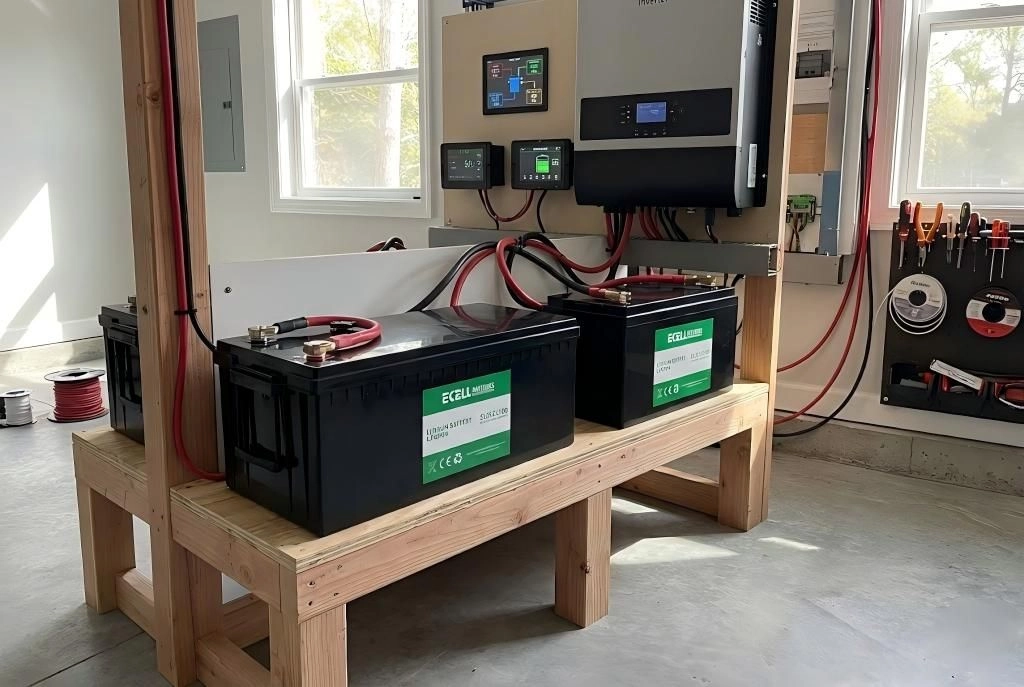
The Case for 12V: Versatility and Compatibility
The 12-volt system is the “universal language” of DC power. If you are building a camper van, a boat, or a small off-grid cabin, 12V is incredibly convenient because most DC appliances (lights, fridges, pumps) run natively on this voltage without needing a converter.
This is where the ECELL ELIS12100 (12.8V 100Ah – 1280Wh) shines. It is designed as a drop-in upgrade for traditional setups. Because it matches the voltage of standard vehicle alternators and existing RV systems, integration is seamless. You don’t need to overhaul your entire electrical infrastructure to enjoy the benefits of lithium iron phosphate technology.
However, 12V systems have a limit. As you approach 2000W or 3000W of inverter power, the current (amperage) gets massive. High amperage means you need thick, expensive copper cables to prevent dangerous heat and voltage drop.
Choose 12V if:
- Your total power load is generally under 2000 W.
- You want to run native 12V appliances directly.
- You are upgrading an existing RV or boat system.
- You want a versatile, scalable building block like the ECELL ELIS12100.
The Case for 24V: Efficiency for Serious Power
When you step up to a 24V architecture, you are essentially cutting your amperage in half for the same amount of power. This is simple physics, but it has huge real-world implications for your wallet and your system’s performance.
By doubling the voltage, you can use thinner cables and smaller fuses, which significantly reduces installation costs. More importantly, 24V systems run cooler and more efficiently. This is critical for systems running sustained loads like air conditioners, large inverters, or workshop tools.
For these robust applications, we recommend the ECELL ELIS24100 (25.6V 100Ah – 2560Wh). This unit packs double the energy density into a clean, single form factor. Instead of wiring two 12V batteries in series—which introduces extra connection points and potential points of failure—you get a dedicated, high-capacity storage solution built specifically for 24V architecture.
Choose 24V if:
- You consistently run loads over 2000 W.
- You want to minimize wiring costs and heat generation.
- You are building a medium-to-large residential solar setup.
- You need the sustained power delivery of the ECELL ELIS24100.
Scalability: Thinking About the Future
One of the biggest mistakes I see professionals make is underestimating future growth. You might start with a few lights today, but tomorrow you will want to run a microwave or a water heater. Your battery bank needs to be able to grow with you.
If you choose the 12V route with the ECELL ELIS12100 (12.8V 100Ah – 1280Wh), scalability is straightforward. You can wire them in parallel to increase capacity (Ah) while keeping the voltage the same. This is perfect for scalable 12V applications where space might be irregular, and you need to fit batteries into odd corners.
On the other hand, the 24V route offers a more streamlined expansion. Using the ECELL ELIS24100 (25.6V 100Ah – 2560Wh) simplifies the battery bank layout. With fewer interconnect cables required to reach high capacity, your battery compartment stays organized, safer, and easier to maintain.
The Verdict: Which ECELL Solution is Right for You?
Ultimately, there is no “wrong” choice, only the choice that fits your energy profile.
If you are retrofitting a vehicle or building a system where native DC appliance compatibility is key, stick with the ECELL ELIS12100. It offers the perfect balance of versatility and efficient performance in a familiar 12V package.
However, if you are designing a new system from scratch intended for high-power residential backup or remote industrial sites, the ECELL ELIS24100 is the professional’s choice. The superior efficiency of the 24V architecture combined with ECELL’s safety features ensures a lower Total Cost of Ownership (TCO) in the long run.
Key Takeaway:
- Go 12V (ELIS12100) for RVs, vans, boats, and small cabins.
- Go 24V (ELIS24100) for off-grid homes, workshops, and high-power backup.
Established in 2006, ECELL BATTERIES INTERNATIONAL LIMITED has evolved into a leading China battery factory dedicated to advanced energy storage solutions. We specialize in the manufacturing of high-performance Lithium Iron Phosphate (LiFePO₄) and Valve Regulated Lead-Acid (VRLA) batteries. As a trusted China battery supplier serving global markets, we are committed to delivering industrial-grade power reliability and innovation.